
Welcome to ECAP
Astroparticle Physics
Astroparticle Physics addresses processes and structures in the interplay of extreme phenomena at smallest and largest scales in the Universe. We know for instance, that particles are accelerated to energies exceeding those of man-made machines by many orders of magnitude. But we still lack a solid understanding of the acceleration mechanisms and the astronomical environment that nature has chosen to realize the cosmic accelerators. Other examples are the physics of black holes and their vicinity, the search for dark matter, the investigation of neutrino properties employing cosmic sources or the quantum structure of space-time.
The ECAP
ECAP is a research centre encompassing the working groups of 11 professors with over 150 scientists. ECAP is an Emerging Field Centre of the University Erlangen-Nuremberg. Together with the astrophysics group at the University of Würzburg it builds up the North Bavarian Science Cluster for Astronomy and Astroparticle Physics.
Our key topics
ECAP combines expertise in the fields of neutrino, X-ray and very-high-energy gamma-ray astronomy. ECAP also integrates the research in neutrino physics, in optical astronomy and the development of new detectors. Theory groups work in quantum gravity and statistical physics. With the ECAP, the University of Erlangen-Nuremberg has created an outstanding framework for scientists to participate in major projects of astroparticle physics: in neutrino astronomy we participate in the projects ANTARES, KM3NeT and IceCube; the experiments H.E.S.S. and CTA work in the field of very-high-energy gamma-ray astronomy; the satellite experiments eROSITA and ATHENA belong to a new generation of X-ray telescopes; EXO-200, nEXO and ORCA investigate neutrino properties. In all of these experiments, scientists of the ECAP are deeply involved in the manifold challenges of constructing and running detectors in such extreme conditions as the deep sea/ice, deep underground or space. Detector development at ECAP is not restricted to fundamental research but is successfully transferred to medical applications.
School for astroparticle physics
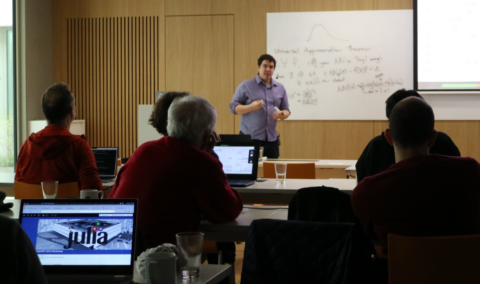
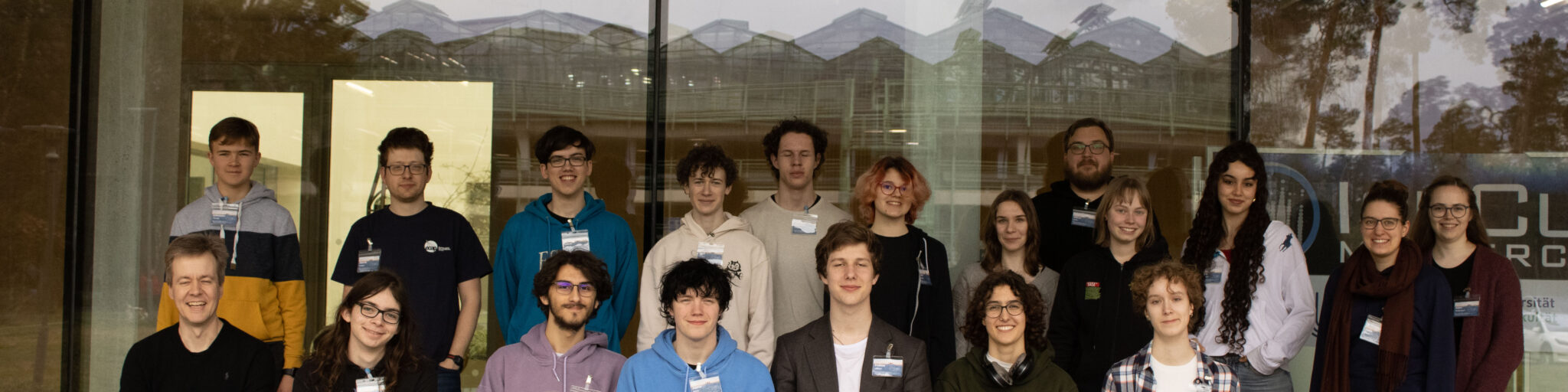
Since the year 2004, the University of Erlangen hosts the School for astroparticle physics (SAT), addressing students from all over Germany and from abroad. Starting 2015 the school is held in English and is open to international participants. The yearly school, running for 10 days in October, allows the participants to deepen their understanding of the fundamental concepts of astroparticle physics, and to gain insight on up-to-date research topics and to get to know each other.